
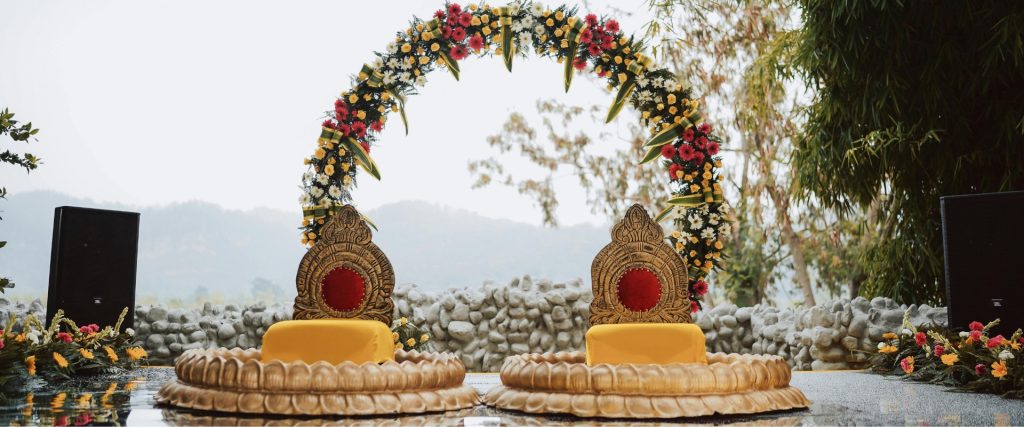
Indian wedding decorations and styling in Singapore have expanded so quickly that most couples now face a different problem than their parents did. There isn’t a shortage of ideas, there’s an overload of them, and very little guidance on which ones will still feel meaningful in a photograph ten years from now versus which ones will simply look like a passing trend.
This guide exists to sort through that noise. Design directions with genuine staying power are separated here from the ones likely to date quickly, with a look at how each idea actually holds up once it meets a real venue instead of a moodboard.
Florals, mandap design, colour, and the smaller personal details couples are choosing to include in their Indian wedding decorations all get covered below, along with how each plays out differently across temple halls, hotel ballrooms, and outdoor venues in Singapore.
Florals Are Being Used Differently This Year
Florals used to mark a spot, the stage, the entrance, the head table. Now they’re doing something closer to architecture, changing how an entire room feels rather than dressing up one corner of it.
- Ceilings are being dressed in cascading floral arrangements rather than a single stage backdrop
- Walkways are becoming full floral tunnels rather than aisles lined with a few stray petals
- Dried and preserved florals are increasingly preferred over fresh ones, since they hold up under warm lighting and don’t wilt through a five-hour event
- Terracotta, brass, and copper accents are replacing a fair amount of the crystal and acrylic that used to dominate prop lists
This is also where sustainability has quietly worked its way into Indian wedding decorations and styling without anyone making a big announcement about it.
The Mandap Isn’t What It Used to Be
Pillared, heavily carved, fully covered, that was close to the default mandap design for a long time. What’s replacing it isn’t one new style so much as a range of them.
- Clean metal or timber frames in place of dense, heavily carved pillars
- Sheer drapery used instead of fully covered canopies
- Structures built to photograph as art in their own right, not just as a backdrop
- Traditional carved-pillar designs still chosen by many couples, now as one option among several rather than the default
A detail worth noting for anyone planning a temple wedding specifically: not every venue can accommodate every mandap style. A structure designed for a hotel ballroom’s high ceilings often needs to be entirely rebuilt for a temple hall with fixed dimensions and a narrow setup window. This is one of the more common gaps between what a couple sees in a photo and what actually gets delivered on the day, and it’s worth raising with a decorator early rather than after a design has already been chosen.
Colour Is Being Used With More Intention
Red and gold aren’t going anywhere in Indian wedding decorations and styling, and for many families they remain the only acceptable choice, tied to meaning that goes well beyond aesthetics.
- Sage, ivory, dusty rose, and icy blue are appearing far more often, sometimes as the main palette
- These softer tones are more commonly layered alongside traditional colours than used to replace them outright
- Couples are increasingly choosing a different palette for each function, quieter tones for the mehndi, bolder ones for the reception, rather than repeating one look throughout
Personal Details Are Taking Centre Stage
This is where the personal touches live, and it’s arguably where the most meaningful shift is happening:
- Name boards and monograms are being custom-designed rather than pulled from a template
- Backdrops increasingly reference something specific to the couple, a shared trip, a family motif, rather than a generic floral wall
- Décor is being planned to flow across the haldi, mehndi, and reception with small variations, instead of being rebuilt from scratch for each function
- Scent, sometimes overlooked entirely in decor conversations, is being used deliberately, jasmine and rose for a more traditional feel, something lighter and more modern for a fusion celebration
None of these changes cost much extra, but within Indian wedding decorations and styling, they tend to matter more to the couple than almost anything else on the decor list, precisely because they’re the details a stock package would never think to include.
Choosing Decorations and Styling for Singapore’s Wedding Venues
Every venue type in Singapore comes with its own constraints that no trend list accounts for on its own.
- Temple halls are efficient but rigid, with décor that needs to go up fast and within a fixed footprint
- Hotel ballrooms offer height and flexibility that suit ambitious floral or structural work, though that scale comes with its own costs
- Outdoor and garden venues fight humidity and unpredictable light, so certain floral choices won’t hold up past the first hour without the right handling
This is precisely where Indian wedding decorations and styling need to be planned against the venue, not just the trend list. None of this is meant to discourage a particular trend, it’s meant to say that the trend and the venue need to be considered together, not separately. At 8 Asthas, this is usually where the actual planning conversation starts, not with a mood board, but with the hall itself and what it can realistically support.
Common Questions on Indian Wedding Decorations and Styling
-
Can the same décor be reused between the mehndi and the reception?
Often, yes. A mandap frame or floral installation, for one, can carry through both events with different accents, cutting down on cost and setup time.
-
What happens to outdoor floral décor if it rains?
Ask about this before booking an outdoor venue. Most experienced decorators already work a backup indoor space or covered structure into the plan rather than scrambling for one on the day.
-
Can two different regional styles be blended into one wedding’s décor?
Yes, and in Singapore’s Indian community, this comes up often within Indian wedding decorations and styling, a Punjabi and a Tamil family, for instance, wanting elements from both traditions represented. It takes more upfront planning, but it’s a common and entirely doable request.
-
How early should décor planning realistically start?
Several months out, particularly for a custom mandap build or large floral installation, given how long sourcing and fabrication actually take. Waiting until a few weeks before the wedding usually means settling for whatever a vendor already happens to have in stock.
In Summary
Indian wedding decorations and styling will keep shifting year to year, but the underlying instinct behind this year’s changes seems fairly consistent: less performing for a camera, more building something that actually reflects the two people getting married.
If you’re working through what that looks like for your own wedding, 8 Asthas can talk through what’s realistic for your venue and your guest count before any final decisions get made. Follow us on Instagram @8asthas for a closer look at our latest work and recent celebrations we’ve had the privilege of styling.

